
Useful Links
Biochemistry on the Internet
http://www.rcsb.org/pdb/
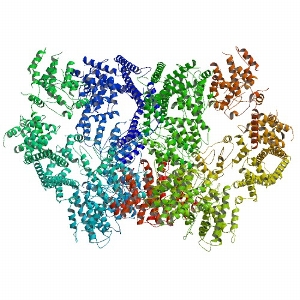
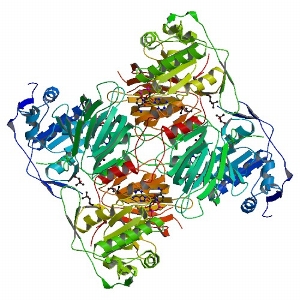
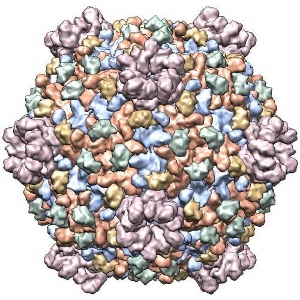
The Protein Database: Formerly housed on the web at
Brookhaven National Labs, this database contains the structures of
thousands of proteins. Scientists deposit structures, determined through
X-ray crystallography and/or NMR, on the database for all the world
to use. To find a given protein, go to the “Search Lite” option and
type in the name of your desired protein. You will then be able to
download a 3-D structure of the protein, in the file format .pdb.
To view the structure, you will need Rasmol (see next link) or some
other. pdb-viewing application.
http://mc2.cchem.berkeley.edu/Rasmol/v2.6/
Rasmol download: Free program used to view PDB structures. Learning
how to use the program is a bit difficult at first, but once you figure
it out, it becomes really useful.
http://www.rcsb.org/pdb/links.html
To find other protein databases, as well as many other useful links,
go here, a link within the protein database web site.
http://www.chemfinder.com/
Chemfinder: Useful site for learning some basic info about a wide-variety
of chemicals, as well as seeing their line-angle structure.
Leading Journals in Biochemistry:
http://www.jbc.org/
Journal of Biological Chemistry: Has all articles from 1995
to the present online, for free, with a very good search engine.
http://acsinfo.acs.org/journals/bichaw/
Biochemistry: Search engine allows you to find articles from
1996-present, but you cannot view anything but the publication information.
http://www.sciencemag.org/
Science: The premier journal in the United States, only the
most important & pertinent research gets published here. On the site,
you can search for articles from 1995-on, and can view their abstracts
if you register with the site (registering is free), but full text
not available w/o $$$
http://www.nature.com/nature/
Nature: The European equivalent of Science, this journal covers
a broad range of topics, and has spun off several more specific sister
journals, such as Nature Genetics and Nature Biotechnology.
On the site, you can search for articles from 1998-on, and can view
their abstracts if you register (free) with the site.
http://library1.hamilton.edu:591/databases/FMPro
Biochemistry Databases from the Hamilton College library. Biological
Abstracts, General Science Abstracts, and Pub Med are your best bets
for finding what you want. If you want to find what articles have
cited a previously published article, go to the Web of Science Citation.
National Organizations in the Sciences:
http://www.nih.gov/
National Institutes of Health. According to their website, “the NIH
mission is to uncover new knowledge that will lead to better health
for everyone.” They dole out money and jobs, like any good government
program should.
http://www.nsf.gov/
National Science Foundation. This government-sponsored program is
one of the biggest funding sources for the sciences in the United
States. Applicants to graduate school are often asked by their prospective
schools to apply for grants from the NSF.
http://www.hhmi.org/
Howard Hughes Medical Institute. Along with the NSF, this private
institution provides loads of dough for scientists. Also like the
NSF, grad students are asked to look for money from HHMI.
Graduate School
http://www.usnews.com/usnews/edu/beyond/bcphd.htm
U.S. News & World Reports rankings for Graduate Schools in the Sciences.
http://www.gre.org/
GRE registration and information