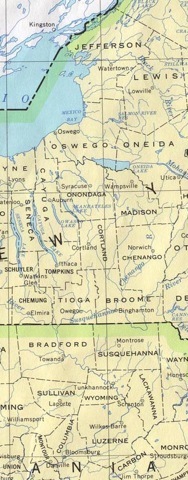







At the heart of the Central New York anti-slavery movement, Utica was a hotbed of abolitionist sentiment and conservative opposition. The tension reached a breaking point in 1835, when 600 delegates met at the Second Presbyterian Church to form a regional division of the American Anti-Slavery Society. Conservative Uticans, including the lower and elite classes, mobbed the Convention, chanting and threatening violence. It was this outbreak that prompted Gerrit Smith to invite the delegates to move the meeting to his home town, Peterboro. This event marks the moment that             turned 38-year-old Smith “from a passive to a militant abolitionist, one of the greatest in 
the country.�1 

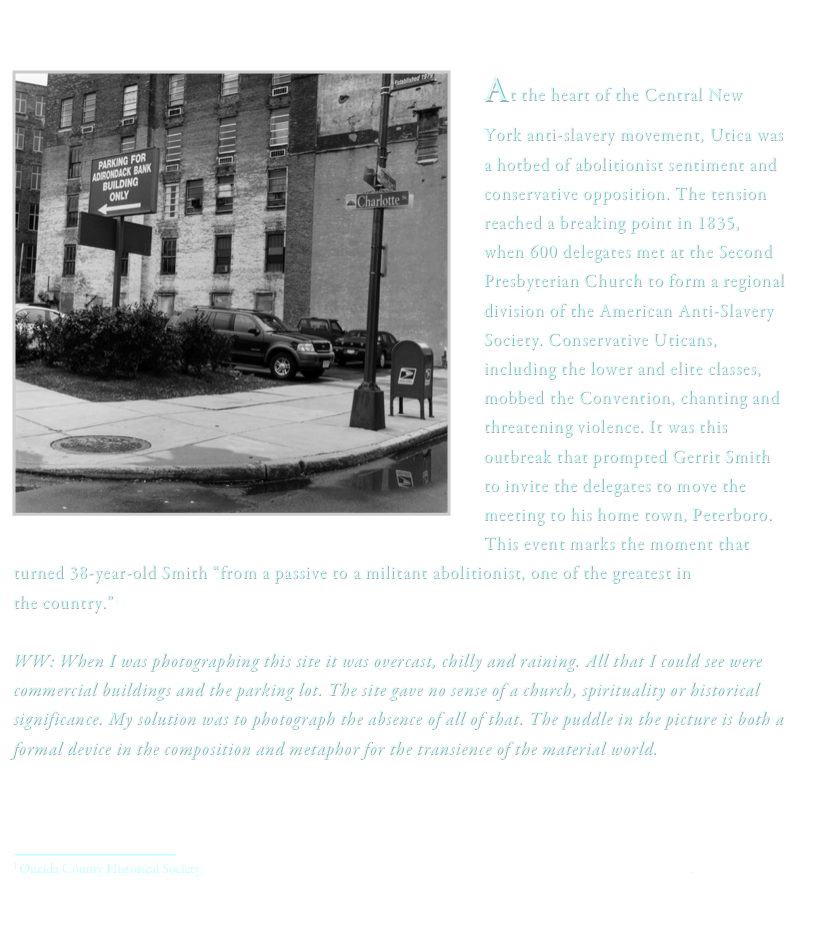
WW: When I was photographing this site it was overcast, chilly and raining. All that I could see were commercial buildings and the parking lot. The site gave no sense of a church, spirituality or historical significance. My solution was to photograph the absence of all of that. The puddle in the picture is both a formal device in the composition and metaphor for the transience of the material world. 


1 Oneida County Historical Society, http://www.oneidacountyfreedomtrail.com/Abolitionism/AbolitionConvention1835.htm.
http://www.oneidacountyfreedomtrail.com/Abolitionism/AbolitionConvention1835.htmshapeimage_2_link_0
Â